
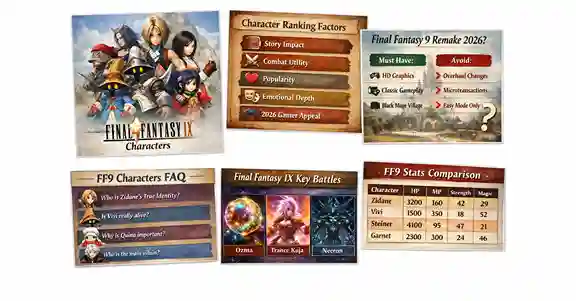
There’s a particular kind of magic that only a handful of games have ever managed to bottle — the kind that makes you stare at the credits rolling for the third or fourth time and feel something lodged in your chest that you can’t quite name. Final Fantasy IX has that magic in abundance, and after 12+ replays across PS1, Steam, Switch, mobile, and now the brand-new GOG Preservation Program release (launched January 29, 2026), I can tell you without hesitation that its cast of characters is the single most important reason why.
Released in 2000 for the original PlayStation, FFIX scored 94 on Metacritic and has sold over 5 million copies worldwide — numbers that would be impressive for any RPG, but feel almost miraculous for a game that dared to be earnest in an era when “dark and edgy” was the prestige default. Hironobu Sakaguchi has called it his most personal Final Fantasy. You can feel that in every frame.
What makes this guide different from the dozen others you’ve skimmed? Three things. First, this is a hybrid tier list — not just gameplay viability, not just poll popularity, but a genuine synthesis of endgame mechanical dominance, emotional staying power, and where each character currently sits in community consciousness heading into 2026.
Second, every character gets a psychological profile and mythological lens you won’t find on any wiki. Third, this guide is fully updated for the current moment: the GOG release finally gives PC players a DRM-free, future-proofed version of one of the best JRPGs ever made, and the remake situation — while genuinely uncertain, with 2025 insider commentary from sources like NateTheHate suggesting development may be “on ice” with no official Square Enix confirmation — makes this the perfect time to (re)engage with the original.
Because here’s what I keep coming back to after all these years: FFIX isn’t primarily a game about saving the world. It’s a game about what it means to be. What it means to exist when your existence was manufactured. What it means to love when you’re afraid you were made incapable of it. What it means to face death — your own, others’, the death of everything — and keep moving anyway.
Those questions live in the characters. Vivi Ornitier asking why he was born. Zidane Tribal confronting the purpose he was designed for. Kuja raging against his own obsolescence. Garnet learning to stop performing composure and start feeling grief. These aren’t just compelling fictional constructs — they’re mirrors.
The GOG version, for those who haven’t grabbed it yet, is the best way to experience or revisit the game in 2026. DRM-free, with preservation-forward support that doesn’t depend on a subscription or a storefront staying solvent. For a 25-year-old game with the community investment FFIX commands, that matters enormously.

Now — let’s talk about the people who make it extraordinary.
Table of Contents

Complete Playable Characters: Roster & Quick Stats
| Character | Role/Class | Weapon | Trance Ability | Key Strength | Visual Icon |
|---|---|---|---|---|---|
| Zidane Tribal | Physical DPS / Thief | Daggers, Thief Swords | Dyne (solo attacks) | Speed, Steal, versatile damage | Monkey-tail blond rogue |
| Vivi Ornitier | Black Mage | Staves | Double Black (dual-cast) | Highest magic damage output | Small black mage with glowing eyes |
| Garnet / Dagger | White Mage / Summoner | Rods, Rackets | Eidolon boost | Healing + summon burst damage | Princess in disguise |
| Adelbert Steiner | Physical Tank / Knight | Swords | Sword Magic amplified | Defense + Swd Magic synergy | Armored knight with round helmet |
| Freya Crescent | Dragoon | Spears | High Jump upgraded | Jump damage, party support | Silver-haired Burmecian rat-knight |
| Quina Quen | Blue Mage / Glutton | Forks | Cook (instant kill) | Blue Magic utility god-tier | Androgynous gourmet creature |
| Eiko Carol | White Mage / Summoner | Flutes, Rods | Boost (summon power) | Best healer, Carbuncle/Fenrir | Small girl with single horn |
| Amarant Coral | Monk / Throw specialist | Claws, Knuckles | Elan (party-hit abilities) | Physical damage, Chakra healing | Scarred red-haired loner |
Temporary/Notable Characters:
- Beatrix — General of Alexandria; arguably the most mechanically and narratively impressive temporary character in FF history
- Marcus & Cinna — Tantalus members with brief playable segments
- Blank — Zidane’s Tantalus brother, brief early-game
2026 Final Fantasy IX Characters Tier List (Hybrid: Gameplay + Story + Popularity)
This tier list synthesizes three pillars: endgame mechanical viability, narrative/emotional weight, and community standing based on recent Reddit, GameFAQs, and TierMaker polls heading into 2026.
S Tier — Essential, Irreplaceable
Vivi Ornitier | Quina Quen
Vivi’s placement here is one of the few times gameplay and community sentiment align perfectly. His damage ceiling is unmatched — Double Black in Trance turns him into a nuclear option that trivializes most encounters, including late-game bosses. But S Tier for Vivi isn’t just a gameplay call: he consistently ranks #1 or #2 in community popularity polls across Reddit’s r/finalfantasy, GameFAQs character contests, and TierMaker community lists. He is the face of FFIX for millions of players.
Quina is the S Tier dark horse — wildly underestimated by casual players, worshipped by veterans. Frog Drop (with 99 frogs caught) is one of the most devastating abilities in the game. Limit Glove at 1 HP delivers 9,999 damage for free. Angel’s Snack provides party-wide status healing. Auto-Life from Roulette cheese. Blue Magic in FFIX is a toolkit that genuinely warps endgame strategy, and Quina holds all the keys.
A Tier — Highly Valuable, Strong Builds
Zidane Tribal | Garnet/Dagger | Eiko Carol
Zidane is your protagonist for a reason — high speed, consistent physical damage, best Steal in the game (mandatory for equipment acquisition), and meaningful late-game Dyne abilities. His A Tier placement isn’t a slight; he’s just outpaced in raw damage by Vivi and raw utility by Quina.
Garnet and Eiko form a fascinating dual-summoner dynamic. Garnet’s Eidolons hit harder and she has access to Bahamut and Odin; Eiko has superior healing utility and Carbuncle’s reflect mechanics. Neither is redundant — they reward different party philosophies.
B Tier — Situationally Strong
Freya Crescent | Steiner
Both are excellent in the early-to-mid game and remain viable throughout. Steiner’s Sword Magic — using Vivi’s spells through his physical attacks for massive hybrid damage — is a legitimately powerful mechanic that many players build entire parties around. Freya’s Jump keeps her relevant and her Dragon-line abilities provide party buffs, but her ceiling is lower in a pure endgame context.
C Tier — Fun, Underserved by the Game
Amarant Coral
Amarant suffers from joining late, having a limited ability pool compared to his peers, and a Trance (Elan) that rarely activates at useful moments. He’s not bad — Chakra is genuinely useful for MP restoration, and his throw damage is respectable — but the game simply didn’t give him enough runway. His story arc, ironically, is more interesting than his kit.
In-Depth Character Spotlights
Zidane Tribal — The Rogue Who Learned to Need People
Who He Is
Zidane is FFIX’s protagonist in the most classical sense — cheerful, flirtatious, brave, and immediately likable. He’s a thief and actor with Tantalus, a traveling theater troupe with a sideline in larceny. From the moment he swings onto the stage of the Prima Vista airship, tail swishing, grinning like someone who has never considered the word “consequence,” you know exactly what kind of story this is going to be.
Except it isn’t. Or rather, it’s that story plus something far stranger and more painful underneath.
Psychological Profile
Zidane maps convincingly onto an ESFP framework — extroverted, sensation-seeking, present-focused, deeply motivated by interpersonal connection. He deflects vulnerability with humor and forward motion. What makes him interesting psychologically is the You Are Not Alone sequence mid-game, where his persona fractures entirely. When Zidane learns the truth about his origins, he doesn’t process it gracefully — he collapses inward, isolates himself, and nearly destroys his relationships. It’s one of the most honest portrayals of masculine emotional crisis in JRPG history.
Story Arc
Without diving into late-game spoilers: Zidane moves from confidence to collapse and back to something more earned — a kind of humility that doesn’t require him to stop being himself. His relationship with Garnet anchors the game’s romantic core, and his brotherhood with Vivi gives the story much of its emotional texture.
Gameplay Guide
- Prioritize Steal — you need it for equipment, period. Budget at least 10-15 minutes per boss stealing attempts before committing to the fight
- Thievery scales with successful steal attempts; grind this early for a powerful late-game physical option
- In Trance, Dyne abilities (Grand Lethal, etc.) deal massive damage — save Trance gauge for bosses
- Equip Brigandine and Protect Ring for defensive coverage; he’s a glass cannon without it
- Best equipment late: Ultima Weapon (dagger), Genji armor set
GOG 2026 Tip: The GOG release runs smoothly with modern controller mapping, making Zidane’s quick-action sequences (like the opening theater battle) feel more responsive than earlier PC ports.
Key Quote: “I want to live. I want to keep trying — that’s all.”
Vivi Ornitier — The Black Mage Who Asked Why
Who He Is
If you polled Final Fantasy fans right now — on Reddit, on GameFAQs, in any corner of the internet where people love these games — Vivi would almost certainly emerge at or near the top. And it wouldn’t be close. He is, in the view of this guide and a substantial portion of the FFIX community, one of the greatest characters in the history of the medium.
He’s also a small child in a hat who sets things on fire.
Psychological Profile
Vivi represents something unusually profound for a JRPG character: a genuinely philosophical protagonist wrestling with existential dread in real time. He doesn’t know where he came from. He learns, gradually and devastatingly, what he is and what that means for how long he has. His response is not rage or denial — it’s a slow, painstaking attempt to build a framework for meaning despite the absence of comfortable answers.
This maps to existentialist philosophy in ways that feel too precise to be accidental. Vivi’s arc echoes Heidegger’s concept of being-toward-death — authentic existence only becomes possible when we genuinely reckon with our finitude. He’s also connected to golem mythology: the black mages are constructed beings, given life through magic, existing in service to purposes they didn’t choose. Vivi’s journey is, in part, about whether a golem can have a soul.
Story Arc
Vivi’s arc is the spine of FFIX’s philosophical ambition. He begins confused and isolated, barely able to articulate his distress. He ends — without spoiling the specifics — in a place of earned, fragile peace. The game asks, through Vivi, whether the value of a life can be measured by its duration. The answer it arrives at is one of the most moving in the series.
Gameplay Guide
- Vivi is your primary damage dealer through most of the game — invest in his magic stat via equipment
- Focus: Doubles magic damage for one turn; use it before hitting a weakness
- Trance (Double Black): Dual-casts magic — activate near HP-rich bosses and watch them evaporate
- Weakness exploitation is essential — Vivi’s kit demands you know enemy elemental vulnerabilities
- Late-game: Mace of Zeus + Pumice Piece accessories maximize damage output
- The Magic Breath Blue Magic from Quina can actually outperform Vivi in multi-element situations, but Vivi’s consistency is unmatched
Mythological Angle: Black mages in folklore traditions across cultures are boundary figures — beings that exist between the living and the magical, the natural and the artificial. Vivi literalizes this liminality. He is matter animated into personhood, and the game never lets him or us forget it.
Key Quote: “I don’t know what dying feels like, but I know something’s missing when someone’s gone.”
2026 Note: Vivi merchandise continues to dominate FFIX fan communities. If any remake materializes, his redesign will be one of the most scrutinized decisions Square Enix could make.
Garnet til Alexandros XVII (Dagger) — The Princess Who Had to Break
Who She Is
Garnet is FFIX’s female lead and one of its most underappreciated characters. Dismissed sometimes as a passive princess archetype, she’s actually something more interesting: a person in the process of dismantling the performance of herself. When she cuts her hair and chooses the name “Dagger,” it’s not a cosmetic moment — it’s a declaration that she is going to choose who she is, even if she doesn’t know yet.
Psychological Profile
Garnet’s arc is fundamentally about grief and agency. She has been raised inside a structure of power and expectation that left her with very little access to her own emotional life. The events of the game, particularly those involving her mother and her homeland, force her to stop managing feeling and start having it. Her temporary loss of voice — rendered mechanically in the game as a period where she cannot summon reliably — is one of the most elegant examples of ludonarrative synchronization in RPG history.
Gameplay Guide
- Garnet’s summons hit harder than Eiko’s; Bahamut and Odin are devastating
- Her weakness is MP — she burns through it fast; equip Ethers/Elixirs liberally
- Rackets give her access to support-oriented abilities; rotate based on what the party needs
- Use her primarily as your summon nuke and secondary healer; let Eiko carry primary healing in late-game
- Carbuncle (Eiko exclusive) outperforms Garnet’s defensive options, so build your party accordingly
Key Quote: “I can’t cry. Why can’t I cry?”
Adelbert Steiner — The Knight Who Learned to Question
Who He Is
Captain of the Knights of Pluto and Garnet’s self-appointed protector, Steiner begins the game as comedy — a blustering, rule-obsessed soldier whose dedication to duty is both admirable and completely blind. He ends it as something quietly heroic. His arc is about loyalty evolving from obedience into conscience: when does following orders stop being virtue?
Gameplay Guide
- Sword Magic (Swd Magic): Pair with Vivi to apply elemental damage to Steiner’s physical attacks — this synergy is one of the most powerful mechanics in the early-to-mid game
- Climhazzard and Shock are his standout abilities late-game
- Equip heavy armor for maximum survivability — he can absorb enormous punishment
- Trance amplifies Sword Magic damage significantly; save it for bosses where Vivi is in the party
- Avoid relying on him as your only attacker in magic-heavy dungeons where he’ll be silenced or slowed
Freya Crescent — The Dragoon Who Lost Everything and Kept Going
Who She Is
Freya is a Burmecian knight (her people are a race of anthropomorphic rats, rendered with extraordinary dignity by the game’s art direction) who joins the party while searching for a lost love. Her homeland has been destroyed. The man she loves doesn’t remember her. She fights anyway.
Psychological Profile
Freya operates under what psychologists might call complicated grief — she is mourning people and places that technically still exist, in altered or diminished forms. Her stoicism isn’t emotional flatness; it’s discipline. The game gives her some of its most quietly devastating dialogue.
Gameplay Guide
- Jump: Her signature ability ignores most ground-based enemy counterattacks; essential for specific fights
- Dragon Crest: Damage scales with number of dragons killed — grind dragons early for massive late-game payoff
- White Draw: Restores MP to all characters — underrated utility
- Luna: Inflicts Berserk on all enemies — situationally powerful
- Mid-game she’s a strong physical option; in endgame she’s outclassed but remains viable with proper builds
Key Quote: “To be forgotten is worse than death.”
Quina Quen — The Devourer Who Devoured the Meta
Who They Are
Quina is, on the surface, the game’s comic relief — a ravenous, androgynous being from the Qu Marsh whose primary motivation is eating interesting things. They speak in broken sentences, pursue frogs across multiple continents, and join the party because their master sends them out to “eat new things.” They are also, without exaggeration, the most mechanically powerful optional character in the game.
Psychological Profile
There’s a genuine reading of Quina as a Taoist archetype — someone who exists in pure, unmediated engagement with the world, without the existential anxieties that torment Vivi or the identity crises that hollow out Zidane. Quina wants to eat. Quina eats. There is a kind of freedom in that. Their master, Quale, implies there is wisdom beneath the appetite — Quina’s journey is framed as a kind of culinary enlightenment quest that the game plays for laughs but never entirely dismisses.
Gameplay Guide — The Blue Magic Bible
This is where Quina earns their S Tier ranking. The Eat/Cook mechanic requires weakening enemies below 1/4 HP to learn their Blue Magic, and building this library is one of the most rewarding optimization loops in FFIX.
Key Blue Magic abilities:
- Frog Drop: With 99 Frogs caught, deals 9,999 damage. The grind is worth it.
- Limit Glove: At exactly 1 HP, deals 9,999 damage. Combine with Auto-Regen management.
- Angel’s Snack: Cures major status ailments for the entire party. Irreplaceable.
- Auto-Life: Resurrection without using items or MP. Absurdly good.
- Mighty Guard: Grants Shell + Protect to entire party. Game-changing for boss fights.
- White Wind: Restores HP equal to Quina’s current HP to all party members.
- Aqua Breath / Aqua: Solid elemental coverage.
- LV5 Death / LV4 Holy: Level-dependent instakills that trivialize specific encounters.
2026 Tip: Quina has experienced a significant community reassessment in recent years. Where they were once dismissed as a joke character, current FFIX discussion on GameFAQs and Reddit consistently places Quina in top-tier gameplay rankings. The Frog minigame — which unlocks Frog Drop — is one of the most genuinely enjoyable side activities in the game, and the GOG version runs it without the lag issues some older PC releases experienced.
Eiko Carol — The Last of Her Kind
Who She Is
Eiko is a six-year-old girl living alone in the ruins of Madain Sari with a family of Moogles. She is the last surviving human Summoner, a designation that carries enormous mythological weight in the FFIX world. She is also fiercely, exhaustingly determined to marry Zidane, which provides consistent comedy against a backdrop of genuine loneliness and loss.
Gameplay Guide
- Primary healer in endgame — her spell list edges Garnet’s for healing utility
- Carbuncle: Reflects magic back at enemies; invaluable for specific boss strategies
- Fenrir: Provides wind/earth damage and useful support effects
- Phoenix: Resurrects all fallen party members; one of the best summons in the game situationally
- Hastega/Slowga: Time magic access makes her incredibly versatile in support configurations
Amarant Coral — The Wall That Needed to Fall
Who He Is
Amarant is FFIX’s brooding loner — a mercenary with a grudge against Zidane, a philosophy of radical self-sufficiency, and a combat style built around his fists and thrown weapons. He joins the party for his own reasons and spends most of his time testing whether his worldview can survive contact with people who genuinely care for each other.
It can’t, quite. That’s the point.
Gameplay Guide
- Chakra: Restores HP and MP to one ally — genuinely useful for MP-hungry parties
- Aura: Fills one ally’s Trance gauge faster — powerful if you can time it correctly
- Throw: Deals damage based on thrown item value; Shuriken throw is potent but expensive
- Trance (Elan): Party-wide versions of his abilities — theoretically strong, rarely activates helpfully
- Best used as a physical attacker and Chakra battery; don’t expect him to carry
Best Party Compositions for Different Playstyles
| Setup | Party Members | Strengths | Weaknesses | Best Against |
|---|---|---|---|---|
| Early Game | Zidane, Vivi, Garnet, Steiner | Strong damage + healing from start | MP fragile | Disc 1-2 bosses |
| Magic Nuke | Vivi, Garnet, Eiko, Quina | Overwhelming elemental + healing | Physically soft | Magic-vulnerable bosses |
| Physical Tank | Zidane, Steiner, Amarant, Freya | Durable, consistent damage | Limited healing | Attrition fights |
| Endgame Boss Killer | Vivi, Quina, Eiko, Zidane | Maximum versatility, top utility | Setup-dependent | Ozma, Necron, Hades |
| Low-Level/Minimal Grind | Zidane, Quina, Eiko, Vivi | Blue Magic cheese, minimal XP needed | Fragile, requires knowledge | Speed/challenge runs |
Endgame Boss Notes:
For Ozma, the most notoriously difficult optional boss: Quina’s Frog Drop (99 frogs), combined with Doomsday spell management (equip Shadow-absorbing gear), Eiko’s Carbuncle for reflect strategies, and Vivi’s Double Black in Trance is the most consistent high-damage approach. Eiko as primary healer with Curaga spam and Phoenix on standby handles the inevitable casualties.
For Necron (final boss): Standard damage spread works well; the key is keeping Auto-Life active on your party via Eiko’s Phoenix or Quina’s Blue Magic. Status ailment protection through equipment is mandatory.
Major Antagonists & Supporting Cast
Kuja — The Narcissist at the End of the World
Kuja is one of the finest villains in Final Fantasy history, which is saying something in a series that includes Sephiroth and Kefka. What separates him is the specificity of his wound: Kuja is obsessed with beauty, power, and legacy because he has been told, in essence, that he has no future. He is a flawed design, scheduled for disposal, raging against a fate he didn’t choose.
This maps with uncomfortable accuracy to certain real-world psychological profiles: the grandiose narcissism that emerges from deep shame, the destruction-as-legacy impulse, the inability to tolerate being ordinary. Kuja isn’t evil because he’s powerful — he’s destructive because he’s afraid.
His aesthetic — androgynous, theatrical, draped in silver — is deliberately operatic. He knows he is performing. The tragedy is that the performance became him.
Queen Brahne — Corruption in Plain Sight
Brahne represents a more grounded form of villainy: a ruler who was genuinely loved, who had genuine capacity for love, who was consumed by avarice and outside influence. Her arc is a cautionary tale about how power corrupts not through dramatic transformation but through small, incremental rationalizations.
Garland — The Architect of Tragedy
Garland (not the FF1 Garland, though the naming is deliberate) is one of FFIX’s most quietly devastating characters. He has been alive for so long, pursuing a purpose so vast and impersonal, that he has lost all framework for individual value. His worldview is logically consistent and morally catastrophic — a portrait of utilitarianism taken to its furthest and most inhuman extreme.
The Black Mages — Children Made for War
The Black Mage village NPCs deserve special mention as a collective character. They are Vivi’s kin — manufactured beings who have awakened to consciousness and built a small community in the time they have left. Their existence is the game’s most direct confrontation with questions of personhood, rights, and what we owe beings we create.
The Moogles — Joy as Resistance
Moogles in FFIX are not comic relief background dressing. They are a civilization with their own communication network (the Mognet system), their own desires and frustrations, and their own quiet dignity. Taking time to deliver Mognet letters is one of the game’s most rewarding side activities, and it enriches the world immeasurably.
FFIX Themes Through Its Characters: Life, Identity, Purpose
Final Fantasy IX is, at its philosophical core, a meditation on three questions that have occupied human thought for as long as humans have been capable of thought: What does it mean to live? Who am I, really? Why does any of it matter?
These questions aren’t posed abstractly — they’re embodied in specific people.
Vivi’s arc is the purest distillation of the life question. He is, as established, a being confronting his own finitude with no philosophical or religious tradition to help him process it. What he arrives at — through friendship, through experience, through the example of others — is something resembling what philosophers call amor fati: love of fate, acceptance of what is, commitment to the living of a life rather than the anguishing over its meaning. He doesn’t solve the question. He learns to carry it.
Zidane’s arc is about identity under extreme conditions. When you discover that your sense of self was partly manufactured — that your personality, your memories, your relationships were all, in some sense, downstream of a purpose someone else assigned you — what remains? FFIX’s answer is both simple and radical: what you do with it. Zidane cannot change his origin, but he can choose his response. That choice is who he is.
Kuja’s arc — and this is what elevates him above standard villainy — is the identity question answered catastrophically. Kuja received the same information Zidane eventually faces and responded with annihilation. The contrast between them isn’t circumstance; it’s character. Kuja never learned what Zidane did: that the people who love you are not just relationships you have — they are, in some real sense, part of what you are.
The purpose question runs through everything. Why do the Black Mages fight? Why does Freya search for Sir Fratley? Why does Garnet risk her life to protect a kingdom that has already failed her? The game’s answer, rendered across every character’s arc, is that purpose is not given — it’s made. It’s made in the relationships you choose, the sacrifices you choose, the values you decide are worth honoring even when no external authority is making you.
In 2026, these themes don’t feel dated. If anything, they feel more urgent. Questions about artificial consciousness, about the ethics of creating beings with limited lifespans, about identity in an age of algorithmic personhood — FFIX was engaging with all of this in allegorical form before most of the real-world conversation existed. This is why it endures. This is why, when people talk about which games genuinely meant something to them, FFIX keeps appearing on the list.
Frequently Asked Questions
Q: Who is the strongest character in FF9? A: For gameplay, Quina (Blue Magic utility) and Vivi (magic damage) share top honors depending on context. Quina’s Frog Drop and Limit Glove can deal 9,999 damage with the right setup; Vivi’s Double Black Trance devastates magic-weak enemies. Quina is more universally useful across enemy types.
Q: What is the best party for endgame bosses in FF9? A: Vivi, Quina, Eiko, and Zidane covers maximum utility — Vivi nukes, Quina handles Blue Magic cheese and status healing, Eiko keeps everyone alive with superior healing and Phoenix, and Zidane steals, deals consistent physical damage, and applies Dyne in Trance.
Q: Does Vivi die in FF9? A: The game is deliberately ambiguous. The ending narration implies the Black Mages — and by extension Vivi — have a natural lifespan shorter than humans. Whether Vivi specifically dies is left poignant and open. Many players interpret the ending as confirming it while others hold out for alternative readings.
Q: Is there any FF9 remake news in 2026? A: As of early 2026, the remake situation is genuinely uncertain. Earlier 2025 speculation and leaks suggested a possible 2026 announcement window, but more recent insider commentary — notably from NateTheHate and similar sources — indicates the project may be paused or “on ice.” Square Enix has made no official confirmation either way. The safest stance is cautious optimism: something may be in development, but don’t plan your calendar around it.
Q: Why is Vivi so popular in community polls? A: Vivi connects on multiple levels simultaneously — he’s visually iconic (the black mage silhouette is one of gaming’s most recognizable designs), his story is emotionally devastating without being manipulative, and his questions are universal. He’s also introduced early and remains emotionally central throughout. Players form attachment fast and deep.
Q: What is the GOG version of FF9 (2026)? A: The GOG Preservation Program release launched January 29, 2026, providing a DRM-free version of Final Fantasy IX for PC. Unlike storefronts that require active account verification, GOG’s model ensures you own the game permanently — a meaningful consideration for preservation-minded players and anyone who remembers the anxiety of digital storefronts shutting down.
Q: Is Quina male or female? A: Quina is explicitly non-binary within the game’s canon — referred to with singular “they” framing in various contexts and described by their master Quale as transcending such categories. This was notably forward-thinking for a game released in 2000.
Q: How do I unlock Quina’s best Blue Magic? A: Frog Drop requires catching 99 frogs at Qu’s Marsh (multiple visits required as frogs respawn). Limit Glove requires Eating a Jabberwock or equipping Angel Ring + Limit Glove + managing to hit 1 HP safely. Mighty Guard requires Eating a Serpion or Antlion early. Prioritize Angel’s Snack (Eat a Zombie) for immediate party utility.
Q: Who should I romance in FF9? A: The game’s romantic arc centers Zidane and Garnet without player choice — it’s a fixed narrative rather than a branching romance system. The love story is genuinely well-written, particularly in how it develops across all four discs rather than resolving neatly.
Q: Is Beatrix playable? A: Beatrix is temporarily playable in a few brief segments. In those segments, she is absurdly overpowered — her Seiken abilities one-shot most encounters. She was clearly designed to feel like playing as a legend. Many fans consider her the game’s best temporary party member in any Final Fantasy.
Q: What’s the best way to experience FF9 in 2026? A: The GOG release is the recommended PC option for DRM-free permanent ownership. The Steam version is also stable and regularly discounted. The Switch port performs well in handheld mode. PS1 original on actual hardware offers nostalgia but lacks QoL features (speed toggle, encounter toggle) available in modern ports.
Q: Which FF9 character is best for a first playthrough? A: Play everyone — the game’s party system forces you to use most characters in various combinations. Pay special attention to Quina despite the comedic framing; learning Blue Magic early dramatically improves your late-game experience.
Q: Is Amarant worth using? A: He’s not broken, but he’s not wasted either. Chakra alone justifies his slot in MP-intensive party builds. His story arc, while underdeveloped, adds meaningful thematic texture — his confrontation with his own philosophy of self-sufficiency is one of the game’s quietly powerful character moments.
Q: What does Trance do in FF9? A: Trance is FFIX’s equivalent of a Limit Break or Overdrive system. The gauge fills as characters take damage. When full, characters automatically enter Trance, which upgrades their command sets. Vivi’s Double Black (dual-cast magic), Zidane’s Dyne abilities, and Steiner’s enhanced Sword Magic are the most impactful Trances.
Q: What makes FFIX different from other Final Fantasies? A: Intentional nostalgia and thematic weight. FFIX was designed as a love letter to the classic FF era — job-based characters, high fantasy setting, ensemble cast — but layered over those familiar structures with some of the most emotionally ambitious writing in the series. It’s simultaneously the most “classic” and one of the most mature entries.
Conclusion: Why These Characters Will Never Get Old
Twenty-five years after a monkey-tailed thief kidnapped a princess on a theater ship, Final Fantasy IX’s cast continues to live rent-free in the heads of millions of people. That’s not nostalgia. Nostalgia is warm but vague — it doesn’t make you stop what you’re doing to explain to someone why a fictional black mage makes you feel things. That’s genuine character work, the kind that only happens when writers and artists are working at the absolute top of their craft.
Vivi’s question — does the length of a life determine its worth? — doesn’t have an expiry date. Zidane’s discovery that you can be shaped by forces outside your control and still choose who you become doesn’t age out. Quina’s chaotic, joyful, appetite-forward approach to existence starts to look like philosophy the longer you sit with it.
If you haven’t played Final Fantasy IX, the GOG release (January 29, 2026) is the perfect entry point — DRM-free, permanently yours, running cleanly on modern hardware. If you’ve played it before, it might be time to go back. The encounter toggle and speed boost options in modern ports make a second or third playthrough significantly more accessible.
And if a remake does materialize — whatever form it eventually takes, whenever Square Enix decides to make an official move — these characters will be ready. Because great characters don’t need updated graphics to matter. They need good writing. They already have it.
Which FFIX character is your favorite? Drop it in the comments — and if you want, share which character you think you’d be in the world of Gaia. Vivi’s philosophical anxiety? Quina’s unfiltered appetite? Freya’s stoic grief? Steiner’s dedicated-but-learning loyalty? There’s a type for everyone.
The game is waiting. It always is.